
In most cases, when we talk about contact lenses recommended in clinics, we refer to soft lenses, worn during the day, which correct vision for myopia, hyperopia, astigmatism, or even presbyopia (the age-related loss of near vision that usually appears after the age of 40).
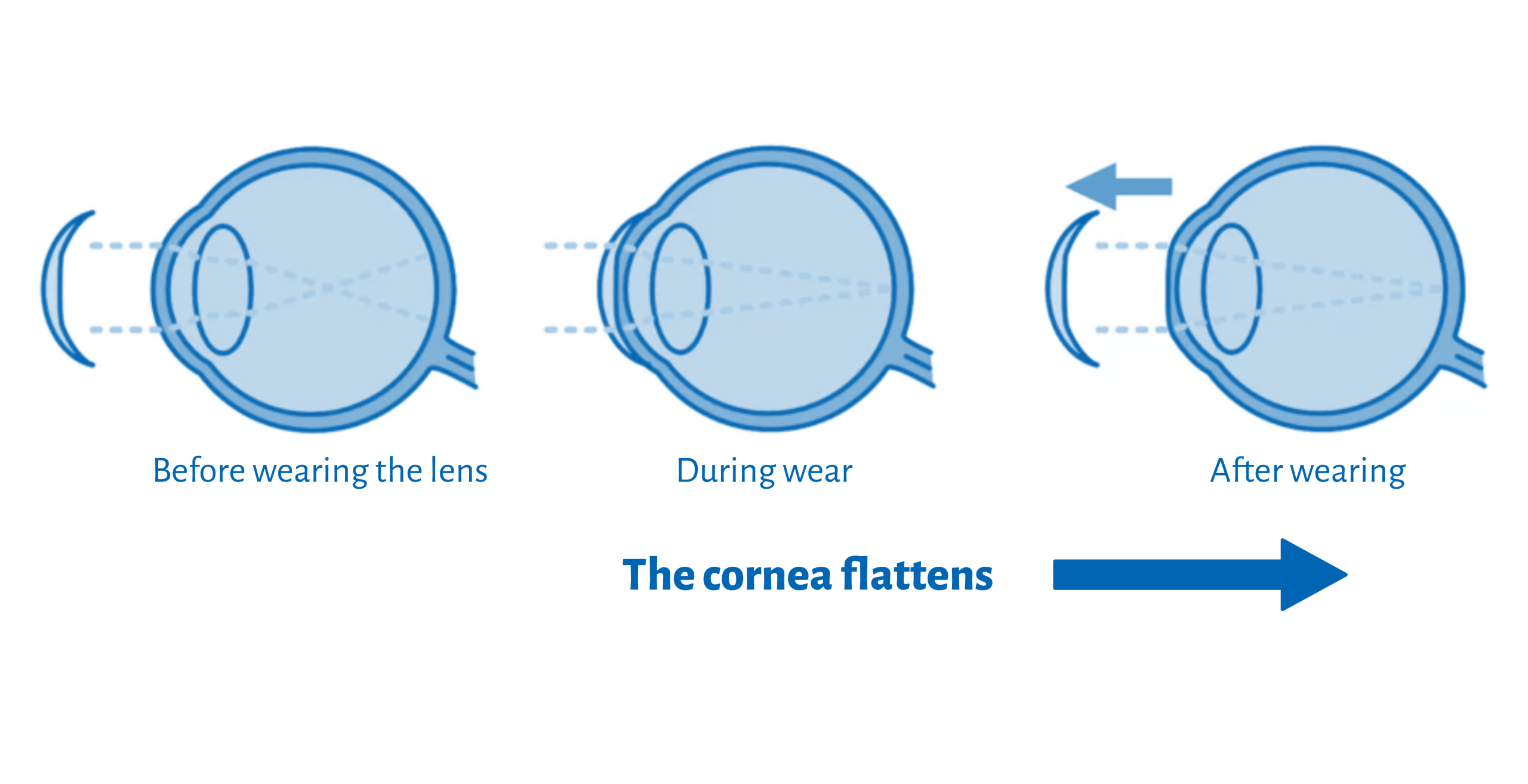
Orthokeratology works differently. It is a type of rigid contact lens that is worn only at night, during sleep. During this time, the lens temporarily reshapes the cornea, and in the morning, after removing it, your vision remains clear throughout the day, without glasses or other lenses.
It is a non-surgical method, used both for vision correction and for myopia management.
How does orthokeratology work?
Orthokeratology is based on the principle of gently reshaping the cornea. The lenses are designed with a special curvature so that, during sleep, they act delicately on the surface of the eye and slightly flatten it.
This change is temporary, but enough for the light entering the eye to be properly focused on the retina throughout the day, resulting in clear vision without glasses or contact lenses.
The method is mainly used to correct myopia and astigmatism, and in certain cases, there are also results for hyperopia or presbyopia.
Who is orthokeratology suitable for?
Overnight lenses, or orthokeratology, are especially suitable for people with myopia, also playing an important role in its management. In children, they can help slow down the progression of myopia, which is why they are often recommended from a young age.
Myopia occurs when the eye grows longer than it should, causing light to focus incorrectly on the retina. The result is blurred distance vision, while near vision remains clear. In most cases, it begins in childhood and can progress over time as the eye continues to grow.
Although they are most commonly used for children, adults with myopia can also benefit from this type of correction.
How long do you need to wear overnight lenses?
The procedure is non-invasive and reversible, which means the effect of the lenses is not permanent. If they are no longer worn, the cornea gradually returns to its original shape, and vision goes back to its previous values.
To maintain the results, the lenses need to be worn consistently, every night.
How do we make sure the lenses are right for you?
Comprehensive initial assessment
We check eye compatibility, overall eye health, and the values of myopia / astigmatism.
Corneal topography
We perform a non-invasive scan that maps the shape of the cornea in detail (3D), providing the data needed for personalized lenses.
Lens design and manufacturing
The lenses are specially designed for your eyes, based on the measurements obtained.
Discussion about wear
We explain the benefits, possible risks, and what wearing the lenses involves, especially in the case of children.
Fitting and adaptation (training)
We apply the lenses and guide you step by step on how to use and properly care for them.
Check-up after the first night
We verify that the lenses are correctly centered and that the eye responds well to wearing them.
Check-up after the first month
We assess the stability of your vision and short-term compatibility.
Regular check-ups (every 6 months)
We monitor the long-term effects. In children, we also track the axial length of the eye to see whether myopia progression is under control.
Annual check-up
We adjust the lens parameters if needed and replace them (their lifespan is generally up to one year).
At Best Optic, we have been working with orthokeratology and myopia management for many years, and every case we see is approached with care, based on the real needs of each patient.
With over 25 years of experience in optometry and more than 15 years dedicated to overnight lenses, we are able to make the right choices and monitor progress over time, ensuring stable and safe results.
If you want to find out whether this method is suitable for you or your child, we invite you to schedule a consultation!
