
Before we explain HOW, let’s understand WHY.
Why choose personalized lenses? Because they significantly enhance your visual perception, offering outstanding clarity and a truly high-definition visual experience.
Here are three key reasons why personalized lenses may be the ideal solution for you. First, the visual field can be up to four times wider compared to conventional lenses, which improves peripheral vision.
Second, they balance image size perception, an important aspect especially when there is a difference in prescription between the two eyes.
Third, the prescription is optimized across the entire surface of the lens, providing the distinctive clarity that defines this type of lens.
By integrating all these aspects, personalized lenses have become the new standard of quality. They are individually designed for each eye, literally. With their aesthetic appeal and superior wearing comfort, they naturally stand out compared to conventional lenses.
But HOW do we personalize lenses?
The personalization process begins during the consultation. Accurately determining your prescription is the first step. Measuring the monocular pupillary distance, separately for each eye, is also essential and should be done by the prescribing specialist. Automated refraction devices typically provide only the binocular pupillary distance, meaning the combined measurement of both eyes. While many practitioners simply divide that value equally between the two eyes, in practice the pupillary distances often differ. These asymmetries must be taken into account to avoid discomfort when wearing glasses.
Next, a suitable frame must be selected, both aesthetically and technically. The personalization process continues with measuring specific parameters of the frame in relation to your eyes, such as the vertex distance, which is the distance between your eye and the back surface of the lens, the fitting height, meaning where you naturally look through the frame, whether centrally or slightly higher, the pantoscopic tilt of the frame when worn and the curvature angle of the frame.
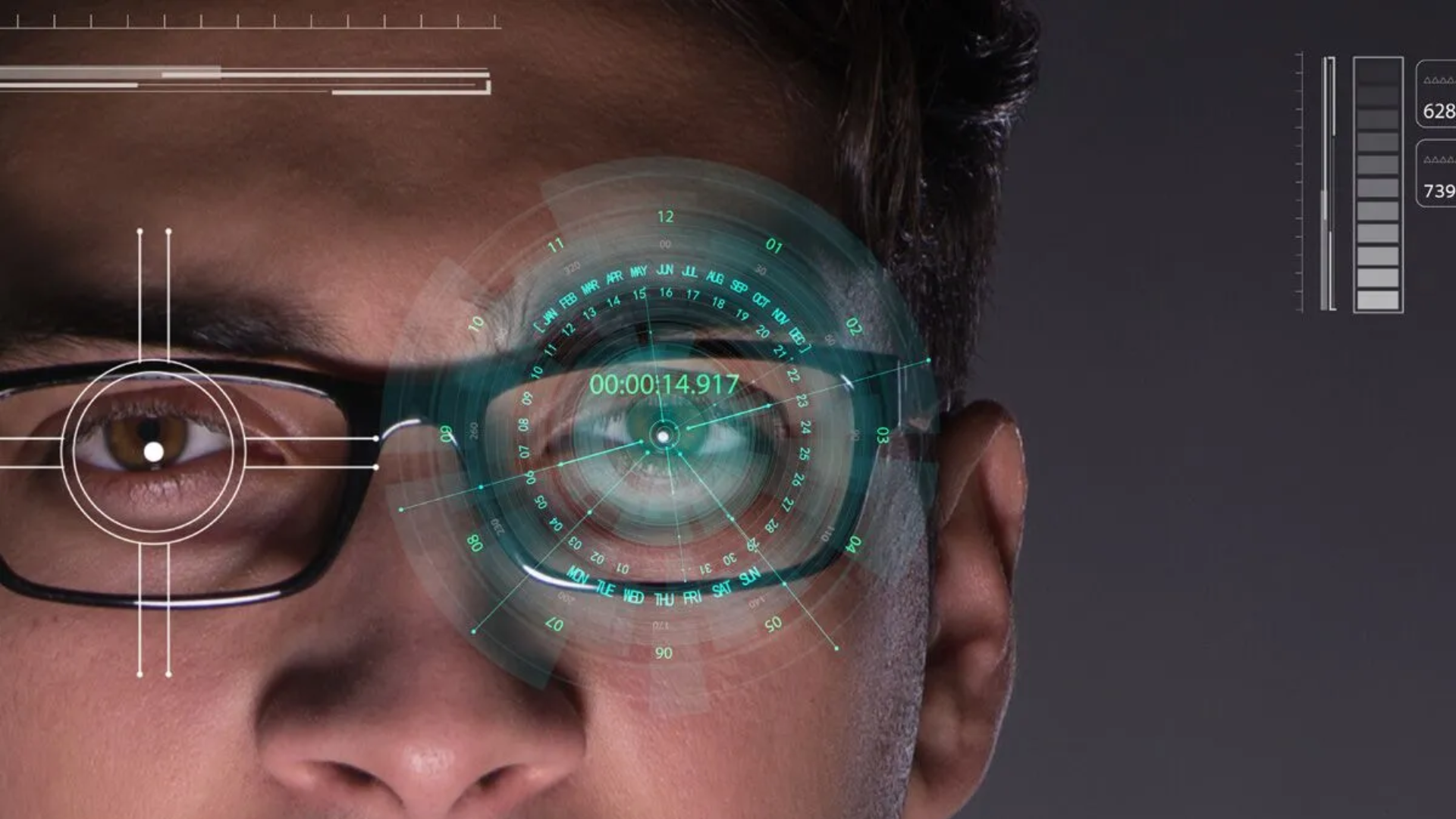
These parameters can be determined manually by the optometrist, but they are far more precise when measured digitally. Using advanced technology, a small sensor is attached to the selected frame while you wear it in its natural position. One or two photographs are taken, and the software algorithm calculates all relevant parameters with millimetric accuracy, automatically correlating your prescription, wearing position and chosen lens type.
This is how we obtain personalized lenses, truly tailored to you and designed to meet your visual expectations. The difference becomes even more noticeable when your lenses are more complex, activity-specific or involve higher prescriptions.
